
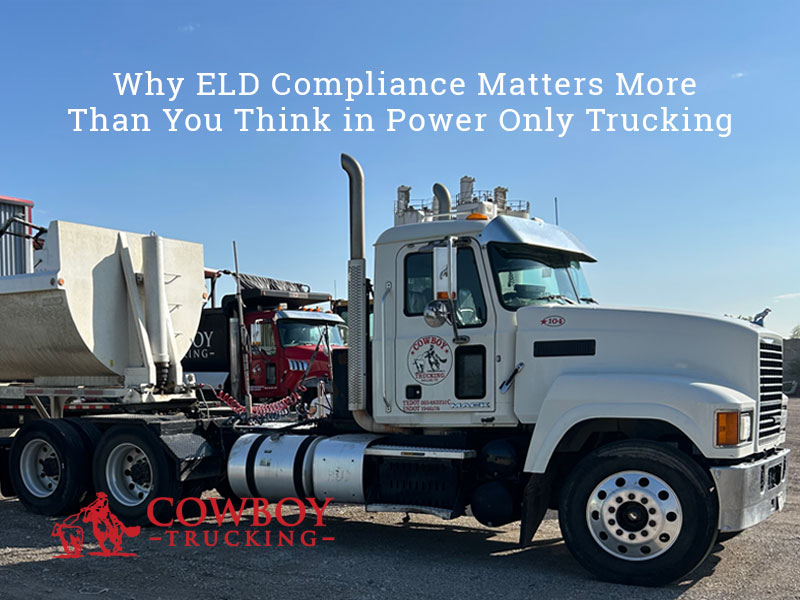
ELD compliance matters more than you think when you’re relying on Power Only trucking to keep your project moving.
On paper, Power Only looks simple. You’ve got the trailer. You need a tractor and a qualified driver to move it. It’s flexible, efficient, and often the fastest way to keep materials or equipment flowing between sites.
But that flexibility depends on one thing that’s easy to overlook: whether the truck and driver can legally roll the moment you need them.
ELD Compliance in Power Only Trucking
ELD compliance is what keeps drivers within legal hours-of-service (HOS) limits. Every move has to be logged, tracked, and available for inspection. If something isn’t right – the device, the records, or the driver’s available hours – that truck doesn’t move.
In a traditional setup, you may have more control or visibility over that. In Power Only, you’re relying on outside capacity.
That makes compliance more than a box to tick. It directly affects whether your trailer gets picked up on time:
- If a driver is out of hours, the load waits.
- If a device isn’t compliant, the truck can’t legally operate.
- When there’s an issue at inspection, your schedule takes the hit.
That’s where Power Only can either work smoothly – or create delays you didn’t plan for.
Where Delays Actually Show Up
From your side as a general contractor, the problem doesn’t look like “ELD compliance.” It shows up as:
- A trailer sitting longer than expected
- A missed delivery window
- Crews waiting on material or equipment
- Knock-on delays across the site
None of that points back clearly to compliance on the surface. But behind the scenes, that’s often where the bottleneck starts.
Power Only works best when your chosen carrier is fully compliant, dispatch-ready, and able to move without hesitation.
Why ELD Compliance Matters More Right Now
Compliance enforcement isn’t static. Devices get removed from approved lists. Rules tighten. Carriers have to stay current to avoid being sidelined.
That creates a gap in the market. Some trucks are ready to move. Others aren’t – even if they’re physically available.
When you’re scheduling tight site activity, that difference matters.
Power Only gives you flexibility, but only if the trucks you’re relying on are fully compliant and ready to go. Otherwise, what looks like a quick solution can turn into another point of friction.
What You Should Expect From a Power Only Partner
As a general contractor, you shouldn’t have to think about ELD compliance day to day. But you should expect your hauling partner to have it handled.
That means:
- Drivers operating within legal hours
- ELD systems that are current and compliant
- No surprises at inspection or dispatch
- Clear communication if anything affects timing
When those pieces are in place, Power Only does what it’s supposed to do: Keep your trailers moving without tying up your own equipment or adding unnecessary delays.
Keep Your Trailers Moving Without the Guesswork
Power Only trucking works when everything behind the scenes is ready to roll. ELD compliance is a big part of that.
Cowboy Trucking has decades of family history proving our reliability in the DFW area and beyond. If you need reliable Power Only support that keeps your schedule moving, give us a call and let’s discuss your unique needs.