
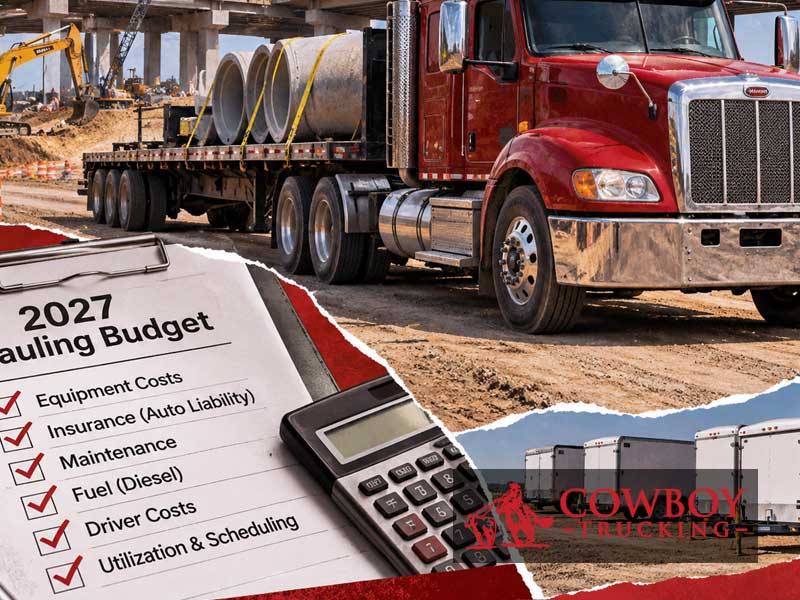
As you prepare your 2027 construction hauling budgets, how much should you allocate to moving equipment and materials between infrastructure sites?
With diesel prices fluctuating and insurance costs remaining a concern, it’s worth looking carefully at how you use your hauling resources.
And with major infrastructure developments across Texas affecting demand for construction resources, planning ahead becomes even more important.
If you own trailers but don’t always have tractors available to move them, power-only trucking could be an economical option.
But when does it make financial sense? And when might using your own fleet be more cost-effective?
What Should You Include in Your 2027 Construction Hauling Budget?
The hourly rate or cost per haul is only part of the calculation.
If you’re considering adding tractors to your fleet, you need to account for the purchase price or financing, depreciation, maintenance, insurance, and driver costs. Some of those expenses continue even when the tractors aren’t working.
Insurance needs particular attention. Commercial auto liability remains a challenging market in Texas, with insurers scrutinizing risks associated with heavy construction and transportation.
It’s also worth checking whether your hauling contractor’s insurance covers every truck assigned to your project.
Diesel adds another uncertainty. Whether you operate your own tractors or contract with a trucking company, fuel costs ultimately affect your budget. With contracted hauling, you should understand how fuel adjustments are handled before agreeing to rates.
And don’t overlook the cost of downtime. A tractor sitting idle or a trailer waiting for collection can create expenses that aren’t immediately obvious in your original estimate.
When Can Power-Only Trucking Reduce Your Hauling Costs?
Consider two different infrastructure contractors.
Contractor A
Contractor A owns several trailers used to transport specialized equipment between highway and utility projects. During excavation and underground utility work, some trailers may remain parked at a site for weeks. But as one phase finishes and another begins, equipment needs relocating, sometimes to several different job sites within a few days.
Buying additional tractors to handle those occasional peaks would leave the company paying for vehicles that spend much of their time parked. Using a power-only trucking service allows the contractor to arrange transport when needed, without taking on those additional ownership costs.
Contractor B
Contractor B has a long-term highway construction contract involving regular movements of equipment between active work zones. The company already owns suitable tractors and employs drivers who can handle those movements as part of their normal schedules.
With equipment and drivers consistently in use, bringing in power-only trucking for routine movements might cost more than using resources already on the payroll.
Neither arrangement is automatically better. The financial advantage depends on how frequently your trailers need moving and whether you have the equipment and drivers to handle the work.
How Can You Build Flexibility Into Your 2027 Hauling Budget?
Our opinion is you don’t necessarily need to make an either-or decision.
For example, you might use your own tractors for predictable, regular movements and arrange power-only trucking when projects overlap or additional trailers need relocating.
The mixed approach could help you avoid investing in equipment solely to cover occasional peaks in demand.
Before finalizing your 2027 budget, consider how often your trailers will move, how long they’ll remain at each site, and whether your current fleet can meet the expected schedule.
It’s also worth discussing with prospective hauling partners their waiting-time charges, minimum booking periods, and insurance responsibilities. These details can change the cost comparison considerably.
Discuss Your 2027 Power-Only Requirements With Cowboy Trucking
If you’re planning infrastructure work across Dallas–Fort Worth, Cowboy Trucking can provide professional drivers and tractors to move your trailers when required.
Tell us what needs moving, where, and how often. We’ll discuss how our power-only services could fit your project schedule and budget.
Give us a call to discuss your 2027 hauling requirements.